
Formula 1 Aerodynamics: How Downforce, Ground Effect and F1 Wings Create Incredible Speed
Formula 1 cars are among the fastest racing machines ever built, but their speed isn’t only created by powerful engines. In fact, one of the biggest reasons Formula 1 cars can corner so quickly and dominate race tracks is something you cannot easily see: Formula 1 aerodynamics.
Modern F1 cars are engineering masterpieces designed to manipulate airflow with incredible precision. Every wing, curve and body panel is carefully shaped to improve performance. The goal is simple: create as much grip as possible while reducing unnecessary drag.
Aerodynamics play such an important role that even small improvements can make the difference between winning and losing a world championship.
In this guide, we’ll explain F1 downforce, ground effect F1, the purpose of F1 wings, and why aerodynamics are at the heart of modern Formula 1.
What Is Formula 1 Aerodynamics?
Formula 1 aerodynamics refers to the way engineers control and direct airflow around the car to improve performance.
The main objectives are:
- Increase grip.
- Improve cornering speed.
- Reduce drag.
- Improve stability.
- Maximize efficiency.
An F1 car’s aerodynamic package can be worth several seconds per lap, making it one of the most important areas of development. Wings and car design play a crucial role in generating downforce, reducing drag, and helping teams maximize performance on every section of the circuit.
Why Are Aerodynamics So Important in Formula 1?
Power alone does not win races.
Even with more than 1,000 horsepower, Formula 1 cars would struggle without aerodynamic grip.
Aerodynamics allow drivers to:
- Brake later.
- Corner faster.
- Accelerate earlier.
- Maintain stability at high speeds.
This is why teams invest hundreds of millions of dollars in aerodynamic research and development.
What Is F1 Downforce?
One of the most important concepts in Formula 1 is F1 downforce.
Downforce is the aerodynamic force that pushes the car toward the ground.
Think of it as the opposite of lift on an airplane.
An airplane wing is designed to make an aircraft rise.
An F1 car is designed to:
Push itself into the track surface.
More downforce means:
- More tire grip.
- Higher cornering speeds.
- Better braking performance.
- Greater stability.
How Much Downforce Does an F1 Car Generate?
Modern Formula 1 cars can generate enormous amounts of downforce, giving them exceptional grip and cornering ability. This aerodynamic advantage, often referred to as the aerodynamics edge, is one of the key reasons why Formula 1 cars can achieve lap times that are far beyond the reach of road-going vehicles.
At high speeds, the aerodynamic forces can exceed:
Several times the car’s own weight.
This is why Formula 1 cars can:
- Corner at incredible speeds.
- Maintain grip in fast turns.
- Change direction extremely quickly.
The amount of grip produced is unlike almost any other racing series.
Aerodynamics Explained: The Science of Airflow
To understand Formula 1 aerodynamics, you need to understand airflow. Every surface of the car is designed to control and direct air efficiently, a concept that drivers such as Jules Bianchi experienced firsthand while competing in one of the most technically advanced forms of motorsport.
As air moves around the car:
- Some air passes over the body.
- Some moves underneath the floor.
- Some flows through cooling systems.
- Some passes around the tires.
Engineers carefully control this airflow to improve performance.
Every small detail matters.
Even tiny changes can influence lap times.
What Is Ground Effect in Formula 1?
One of the biggest topics in modern Formula 1 is ground effect F1.
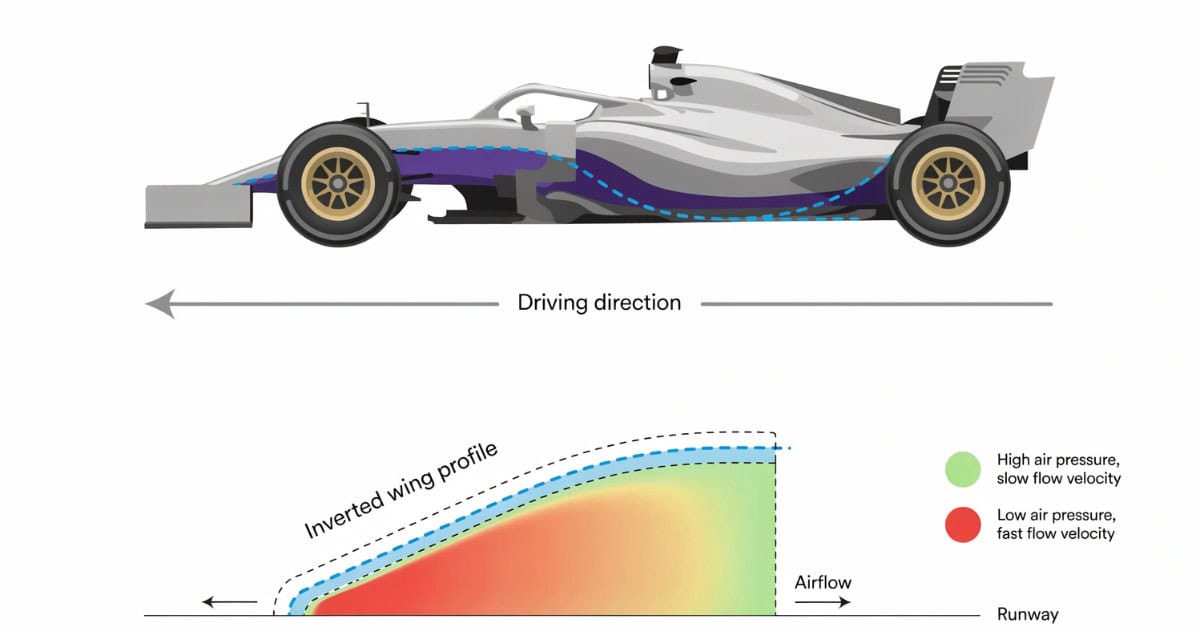
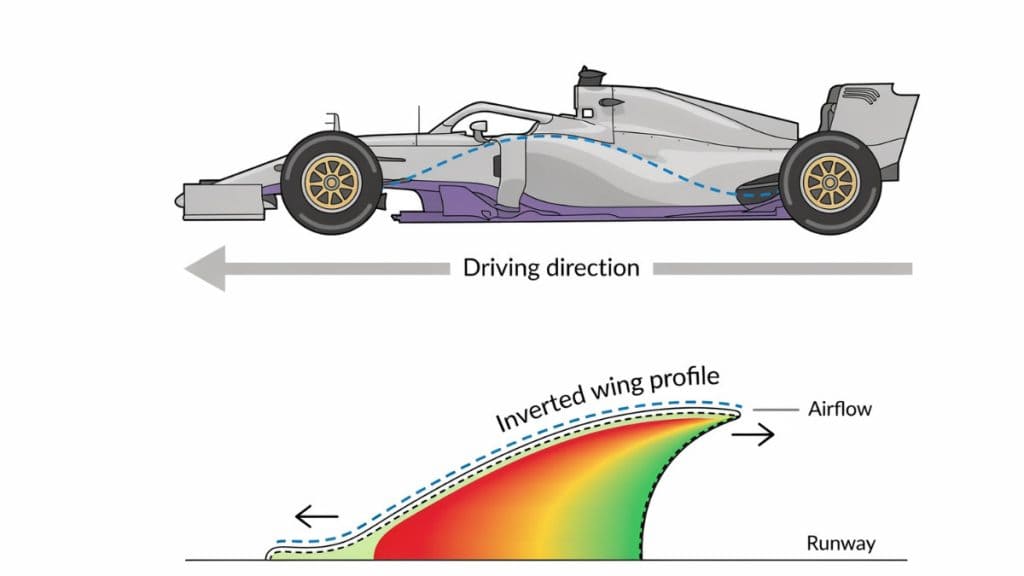
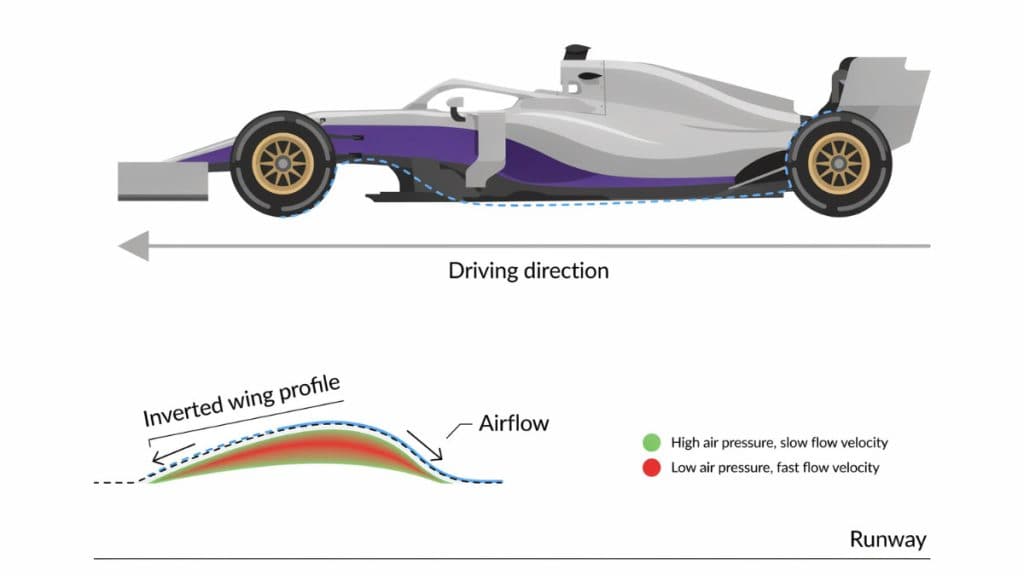
Ground effect is an aerodynamic concept that uses the underside of the car to create downforce.
Instead of relying entirely on wings, the floor of the car acts like an inverted wing.
This creates:
- Low pressure beneath the car.
- Increased suction toward the track.
- More grip with less drag.
Ground effect allows cars to produce large amounts of downforce more efficiently.
Why Did Formula 1 Bring Back Ground Effect?
Formula 1 reintroduced ground-effect cars in 2022.
The main goal was to improve racing.
Previous cars created “dirty air,” making it difficult for drivers to follow one another closely.
Ground-effect cars:
- Lose less performance when following another car.
- Improve overtaking opportunities.
- Produce more efficient downforce.
This regulation change has had a major impact on modern Formula 1 racing. It has reshaped Formula 1 racing dynamics by influencing overtaking opportunities, tire management strategies, aerodynamic performance, and the overall competitiveness of the field.
What Is Dirty Air?
Dirty air refers to disturbed airflow created behind a Formula 1 car.
When another driver follows closely:
- Airflow becomes turbulent.
- Front wings lose efficiency.
- Downforce decreases.
- Tire wear can increase.
This makes overtaking more difficult.
Reducing dirty air has become one of Formula 1’s biggest engineering challenges.
Understanding F1 Wings
The wings on an F1 car are among its most recognizable features.
The two most important are:
- Front wing
- Rear wing
Both play critical roles in aerodynamic performance.
Front Wing
The front wing is the first component that meets the airflow.
Its job is to:
- Direct airflow.
- Generate front-end downforce.
- Control air around the tires.
- Improve balance.
eams spend enormous amounts of time optimizing front wing designs, as even small aerodynamic improvements can significantly affect overall performance. These continuous refinements often lead to exciting updates and thrilling moments throughout the season, as teams compete to gain every possible advantage on the track.
Rear Wing
The rear wing creates:
- Rear downforce.
- Stability.
- Traction.
It also plays a role in Formula 1’s famous DRS system.
What Is DRS?
DRS stands for:
Drag Reduction System
The system allows drivers to open a section of the rear wing.
This reduces:
- Drag.
- Air resistance.
As a result:
- Top speed increases.
- Overtaking becomes easier.
DRS has become one of the most important tools for passing in modern Formula 1. As one of the sport’s most influential technological innovations, it helps reduce aerodynamic drag on straights, creating more overtaking opportunities and enhancing wheel-to-wheel racing.
Why Don’t Teams Simply Add More Downforce?
More downforce sounds perfect, but there is a trade-off.
Increasing downforce usually creates:
- More drag.
- Lower top speed.
- Reduced straight-line performance.
Teams constantly search for the perfect balance between:
- Cornering speed.
- Straight-line speed.
This balancing act is one of Formula 1’s greatest engineering challenges.
Formula 1 Wind Tunnel Testing
Aerodynamic development relies heavily on:
- Wind tunnels
- Computer simulations
- CFD (Computational Fluid Dynamics)
Wind tunnels allow engineers to:
- Test airflow.
- Analyze designs.
- Measure aerodynamic performance.
Every Formula 1 team uses advanced technology to improve its aerodynamic package. Teams such as Red Bull Racing invest heavily in wind tunnel testing, computational simulations, and on-track development to maximize performance and gain a competitive edge.
Why Are F1 Cars Covered in Small Aero Parts?
Modern Formula 1 cars feature:
- Winglets
- Turning vanes
- Deflectors
- Cooling ducts
- Complex floor designs
Each component has a specific purpose.
Together, they control airflow with incredible precision.
How Aerodynamics Affect Lap Times
Aerodynamic improvements can dramatically improve performance.
A more efficient car can:
- Corner faster.
- Brake later.
- Preserve tires better.
- Improve overall pace.
In Formula 1, even a few tenths of a second per lap can determine championships.
The Most Aerodynamically Advanced F1 Cars
Several Formula 1 cars are famous for their aerodynamic excellence.
Red Bull RB19
Often considered one of the most efficient aerodynamic designs ever built.
Mercedes W11
Dominated the 2020 season with exceptional balance and performance.
Williams FW14B
A revolutionary car that changed Formula 1 engineering.
These cars demonstrate how important aerodynamics are in Formula 1 success.
Can Formula 1 Cars Drive Upside Down?
Theoretically, yes.
At high enough speeds, Formula 1 cars generate enough downforce to support their own weight upside down.
In reality:
- Safety concerns
- Fuel systems
- Practical limitations
make this impossible to demonstrate on a race track.
However, it highlights just how extraordinary Formula 1 aerodynamics truly are.
The Future of Formula 1 Aerodynamics
Formula 1 regulations continue to evolve.
Future goals include:
- Better racing.
- More overtaking.
- Increased sustainability.
- Reduced dirty air.
Engineers will continue searching for new aerodynamic solutions while staying within the sport’s strict regulations.
Innovation has always been at the heart of Formula 1.
Final Thoughts
Formula 1 aerodynamics are the invisible force that makes modern F1 cars so extraordinary. Through advanced engineering, teams create enormous F1 downforce, use ground effect to improve efficiency, and carefully design F1 wings to maximize performance. These innovations also play a crucial role in overtaking in Formula 1, as they influence how closely cars can follow one another and how effectively drivers can execute passing maneuvers.
Without aerodynamics, Formula 1 cars would be far slower, less stable and far less spectacular to watch.
As technology continues to evolve, aerodynamics will remain one of the most fascinating and important aspects of Formula 1 engineering.
Frequently Asked Questions
What is Formula 1 aerodynamics?
It is the science of controlling airflow around the car to improve grip, stability and speed.
What is F1 downforce?
Downforce is the aerodynamic force that pushes the car toward the track, increasing tire grip.
What is ground effect in Formula 1?
Ground effect uses the underside of the car to create downforce more efficiently.
Why are F1 wings so important?
The front and rear wings help generate downforce and control airflow around the car.
What is dirty air?
Dirty air is turbulent airflow behind a car that reduces aerodynamic performance for following drivers.
Why do Formula 1 teams use wind tunnels?
Wind tunnels allow engineers to test and improve aerodynamic designs.
Can an F1 car drive upside down?
Theoretically yes, because of the huge amount of downforce it generates, although this is not practical in real-world conditions.